Classical vs acoustic guitar: which one should you learn on?
Nylon strings are kinder to new fingertips, and that's the reason most people hear first. But sore fingers fade in a few weeks. The sound and the neck stay with you, so start from the music you want to play.
 By Douglas MatosoUpdated
Heads up: we earn a commission if you buy through our Amazon links, at no cost to you. It never decides our picks. Affiliate disclosure
The short answer
Both are acoustic guitars. In US stores, "acoustic" means a steel-string guitar and "classical" means a nylon-string one. Buy a steel-string if you want to strum and sing pop, rock, folk or country songs. Buy a classical if you love the soft nylon sound or want to play classical, flamenco or bossa nova. Nylon is gentler on your fingertips, which matters most for young kids, but the soreness from steel strings fades within a few weeks of regular practice.
Side by side
| Classical (nylon) | Acoustic (steel-string) | |
|---|---|---|
| Strings | Nylon trebles; basses with a nylon core wound in metal wire | Steel, with bronze-wound basses |
| String pull on the neck | About 80 to 90 lb | About 160 lb (light gauge) |
| Neck width at the nut | About 52 mm (2 in), flat fingerboard | About 43 mm (1.7 in) |
| Truss rod | Usually none | Yes, adjustable |
| Neck joins the body at | The 12th fret | Usually the 14th fret |
| Sound | Warm, soft, quieter | Bright, louder, cuts through |
| Usually played with | Fingers or fingernails | A pick or fingers |
| On new fingertips | Gentle | Sore for the first few weeks |
| Typical music | Classical, flamenco, bossa nova, Latin, fingerstyle jazz | Pop, rock, folk, country, blues, singer-songwriter |
| Examples | Yamaha C40 | Yamaha FG800, Fender CD-60S |
Both are acoustic guitars
Any guitar that makes its sound without electronics is an acoustic guitar, and that includes classical guitars. Reddit threads on this question always have someone pointing it out. In American stores and on Amazon, though, “acoustic guitar” means a steel-string guitar, and “classical guitar” means one with nylon strings. That’s how we use the words here.
Outside the US the default flips. As one r/guitarlessons commenter puts it, pretty much everywhere outside the English-speaking world, the classical is the standard acoustic guitar. So if a parent or teacher abroad calls a nylon-string guitar “the acoustic,” they aren’t wrong.
How they’re built
The strings come first, and most of the other differences follow from them. A steel-string guitar’s light-gauge set pulls on the neck with about 160 pounds of force, going by D’Addario’s tension charts. A normal-tension nylon set pulls with about 80 to 90. That changes how each guitar has to be built.
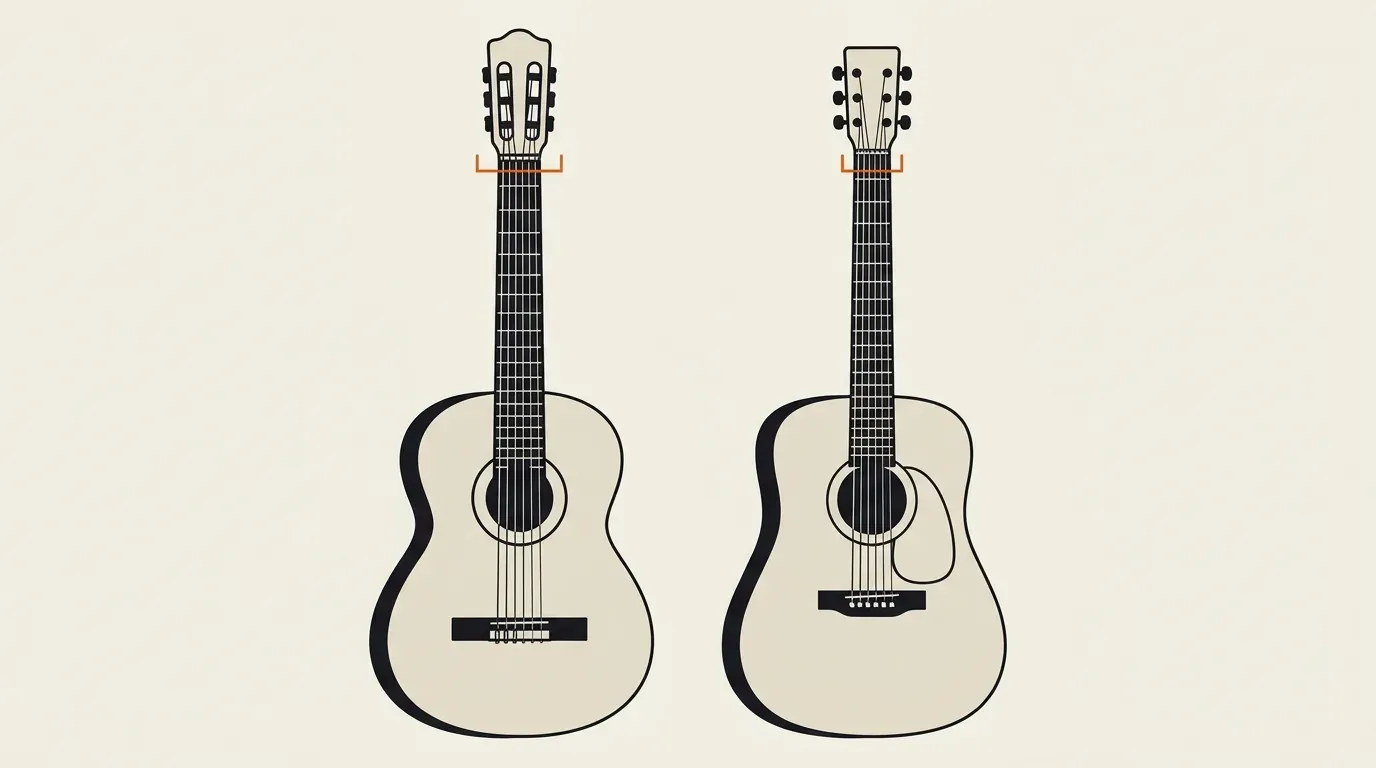
Classical (left) and steel-string (right). The classical’s neck is wider at the nut and meets the body two frets sooner.
Nylon strings vibrate in a wider arc, so classical necks are wider, with more room between strings. Yamaha’s C40II is 52 mm (about 2 inches) at the nut. The FG800, the top pick in our beginner acoustic guitar guide, is 43 mm. The classical fingerboard is also flat.
A steel-string neck has an adjustable metal rod inside, the truss rod, to resist that 160-pound pull. Most classical guitars, including the cheap Yamahas, don’t have one, because nylon doesn’t need it.
Classical strings are tied around the bridge and wound onto rollers in a slotted headstock. Steel strings have a ball at the end, held in the bridge by pins. And on a classical, the neck meets the body at the 12th fret. On most steel-strings it’s the 14th, so you can reach a little higher up the neck.
How they sound and feel
A steel-string sounds bright and loud. It’s the sound on most pop, rock, folk and country records of the last century, and it carries when you strum and sing. A classical sounds warm, round and quieter. It suits fingerpicked melodies, and it’s the voice of classical guitar, flamenco and bossa nova.
Owners describe the difference in practical terms. In an r/AcousticGuitar thread from a beginner who wanted to play pop, folk and rock, one reply says classical “sounds bad with a flat pick” until you learn a strumming technique for it, so if you mostly want to accompany yourself singing, “steel string is your best bet.” Another says strumming big chords on nylon “can sound kind of floppy.” On the other side, one r/guitars commenter calls classicals quiet enough to make “really good guitars to dick around on when you’re watching TV on the couch.”
Nylon also has limits for some styles. Note bends, a staple of blues and rock, barely work on nylon strings, and one r/guitars commenter calls them “kind of useless for bends.” A classical isn’t as loud in a group, either. One reply in an r/guitarlessons thread warns it “may not be loud enough in an ensemble setting.”
None of that stops anyone from playing any song on either guitar. Willie Nelson has played the same nylon-string Martin, with a pick, for most of his career.
Sore fingertips
Nylon strings are easier on your fingertips. Steel strings press into the skin, and new players get sore fingers until calluses form. How long that takes depends on how much you play. One player who owns both puts it at “a week or two of consistent playing,” and another, who started at 15 on steel, says it hurt for the first month.
That’s why the advice to start on nylon is so common, and why it splits Reddit. The top reply in that r/AcousticGuitar thread recommends starting on steel, because “you’ll find it hard to then play acoustic. It’s easier the other way around.” Another warns that picking nylon only because it’s easier on the fingers “will not serve you and could lead to disinterest” if steel-string songs are why you want to play. A guitarist of 30 years in the same thread went the other way and started his young daughters on classicals: “I don’t want their progress slowed by finger pain.”
The guitar’s setup matters as much as the strings. In an r/Guitar thread from a frustrated beginner on a classical, a reply with six upvotes says it’s “MUCH easier to play nylon strings with super high action than it is to play steel strings with proper action.” But high strings make either guitar hard to play. Four of the top eight Amazon reviews of the FG800 in our research say its strings sat too high out of the box, and one of those owners raised the rating to five stars after a shop setup. Cheap classicals often come with high strings too, and since there’s no truss rod, a tech lowers them by sanding the saddle and filing the nut.
If steel strings hurt, you have options before switching guitars. Lighter strings (extra light, or 10s) and silk and steel strings both cut the tension. A teacher of 20 years in an r/guitarlessons thread suggests silk and steel for kids whose fingers hurt.
Neck width
The soreness wears off, but the neck you buy is the neck you keep. A wider neck gives your fingers more room for each note, which classical and fingerstyle players like, but chords mean a longer stretch. The top reply in that r/Guitar thread from the struggling beginner says classical necks are wider and their fretboards flatter, “which gives them a very different feel from the jump.” Several players in our reading say barre chords are harder on a classical, though one reply says the stiffer steel strings make barres harder on a steel-string. One player who plays chords with the thumb wrapped over the neck found a classical “too wide for me to reach.” Others don’t mind. A reply in an r/guitars thread points out that a beginner “won’t really notice” the wide neck, with nothing to compare it to.
Hand size matters here. If your hands are small, try a classical in a store before you buy one, or look at a 7/8 or 3/4 size. If you love the nylon sound but not the neck, crossover guitars like the Córdoba Fusion 12 have nylon strings on a narrower 48 mm neck with a truss rod. A commenter on r/classicalguitar sums them up: “This is for acoustic guitar players who want nylon strings but don’t like the thick neck of classical guitars.”
Switching later
Whichever you start on, your skills carry over. Players who learned on a classical say the move to steel mostly means building calluses. “Outside of calluses, it’s easier to go from classical to steel string,” says one reply in an r/Guitar thread that asks this exact question. Going the other way, from steel to nylon, one r/classicalguitar reply says the wider neck took “a week or two to feel comfy with.” Chord shapes, rhythm and reading tab are the same on both. One reply in an r/guitarlessons thread puts it bluntly: the type of guitar won’t make you progress, “only practice will.”
Don’t swap string types to switch. Steel strings on a classical can bow the neck or pull the bridge off, and nylon strings on a steel-string guitar don’t fit the nut and won’t hold tune.
Which one should you buy?
You want to strum and sing pop, rock, folk or country
A steel-string. It’s the sound you’re trying to copy, and it’s built for a pick. Get one with a good setup and light strings, and expect a few weeks of sore fingertips. Our beginner acoustic guitar guide covers five, with what owners say about their string height out of the box.
You want to play classical, flamenco, bossa nova or Latin music
A classical. That music is written for nylon strings, wide string spacing and fingernails, and it doesn’t sound right on steel. The Yamaha C40 is a common first classical: it ranks third among classical guitars on Amazon, with 4.6 stars from 454 ratings.
You mostly want to fingerpick
Either. Classical technique carries over to steel-string fingerstyle, and plenty of fingerstyle players use steel. Listen to players you like and buy the sound you want to hear when you practice.
You’re buying for a young child
For kids under about 10, a small guitar matters more than the string type, and teachers in the threads we read lean toward nylon or an electric guitar. Look for a 1/2 or 3/4 classical, or a well set-up 3/4 steel-string like the Yamaha JR1 if your child wants the sound of the songs they hear. A Reddit guitar teacher’s rule for size: with the hand at the first fret, the fretting arm should bend at the elbow, not stretch out.
You aren’t sure what you’ll play
A steel-string, for most adults. It covers more of the music most beginners want to play, and our acoustic guide is a good place to start. If you’re drawn to the nylon sound when you hear both, trust that instead. One reply in the r/AcousticGuitar thread puts it this way: “pick whatever is going to get you playing more.”
Once you have one, our free guitar chord chart shows the shapes, and the guitar tuner works for both nylon and steel.
Ready to pick one?
Questions beginners ask
Is a classical guitar easier for beginners?
For your fingertips, yes. Nylon strings pull on the neck with about half the force of steel strings and press down more easily. The neck is another story. A classical neck is about 52 mm wide at the nut, against about 43 mm on a steel-string like the Yamaha FG800, so chords mean a bigger stretch, and many players find barre chords harder on it. Owners on Reddit split on which is easier overall. What most of them agree on is that the guitar's setup matters more: a steel-string with high strings is hard to play, and so is a classical.
Which is harder to learn, classical or acoustic guitar?
It depends more on the music than the guitar. Classical guitar as a style asks for its own technique, posture and, ideally, well-kept fingernails, and one player who has played steel for a decade says most steel-string songs are easier than classical pieces. The instruments themselves are close. Players who start on a classical say their skills carry over to a steel-string, and players who move the other way say the same.
Can I put steel strings on a classical guitar?
No. Steel strings pull roughly twice as hard as nylon, and most classical guitars have no truss rod to hold the neck against that. The neck can bow, and the bridge can pull off the top. The nut slots and string height are wrong for steel too. If you want a classical to feel lighter, try low-tension nylon strings instead.
Can I put nylon strings on an acoustic guitar?
Not well. Classical strings don't seat in a steel-string guitar's narrower nut slots, and the guitar is set up for much higher tension. One owner who put nylon strings on a Yamaha FD01S couldn't get them to hold tune for more than a few hours. If steel strings hurt, put on a lighter steel set (extra light or 10s) or silk and steel strings, and have the guitar set up.
Can you play pop and rock songs on a classical guitar?
Yes. Any chord works on any guitar, and plenty of people learn on a classical and play pop on it for years. It will sound softer and rounder than the recordings, which are mostly steel-string. Willie Nelson has played the same nylon-string Martin with a pick for decades, so a pick works too, though strummed nylon can sound a little loose next to steel.
Which is better for a child, classical or acoustic?
For kids under about 10, most of the teachers we read lean toward nylon strings or an electric, both because the strings are easier to press and because a small guitar is a must. Classical guitars come in 1/4 to 3/4 sizes for that reason. One teacher of 20 years says it depends on the kid, and another guesses only 5 to 10 percent of young students struggle with sore fingers on steel. If your child wants to play songs they hear on the radio, a well set-up 3/4 steel-string like the Yamaha JR1, with light strings, works too.
Can you plug in a classical guitar?
Only if it has a pickup built in. Classical acoustic-electric guitars, such as the Córdoba Fusion 12 with its Fishman pickup, plug into an amp or a PA like any acoustic-electric. The clip-on magnetic soundhole pickups sold for steel-string guitars don't work with nylon, because they need steel strings to pick up.
Why does my new classical guitar keep going out of tune?
New nylon strings stretch for days before they settle. Retune often, and gently pull each string away from the fretboard a few times after tuning to speed it up. Nylon also reacts more to temperature changes than steel, so a classical drifts more when you move it between rooms. Our free [guitar tuner](/tools/guitar-tuner/) works with either kind.