Open-back vs closed-back headphones: which one fits where you listen?
Soundstage gets most of the attention, but a microphone, a roommate or a noisy street usually settles the choice first. Here's how to tell which earcup suits the place you listen.
 By Douglas MatosoUpdated
Heads up: we earn a commission if you buy through our Amazon links, at no cost to you. It never decides our picks. Affiliate disclosure
The short answer
Buy closed-back headphones if you record with a mic, share the room with someone, or listen anywhere noisy. They block the outside and keep your music in. Buy open-back headphones if you listen or mix alone in a quiet room and want a wider, more natural sound. They leak both ways. If you can only own one pair, get closed-back.
Side by side
| Closed-back | Open-back | |
|---|---|---|
| Earcup | Sealed shell behind the driver | Grille or vents behind the driver |
| Outside noise | Blocked fairly well | Comes straight in |
| Leakage | Low, until you turn it up a lot | People nearby and your mic hear it |
| Sound | Closer, in your head, more bass punch | Wider and more like speakers in a room |
| Comfort | Ears get warm over long sessions | Cooler, air moves through |
| Best for | Recording, shared rooms, commuting, noisy homes | Mixing, quiet solo listening |
| Common examples | ATH-M50x, Sony MDR-7506, DT 770 Pro | Sennheiser HD 560S, DT 990 Pro |
What “open” and “closed” mean
Every headphone driver pushes sound two ways: forward into your ear and backward out of the earcup. The back of the cup decides what happens to that second half.
On closed-back headphones, the back is a solid shell. The sound that goes backward stays inside the cup, and the shell plus the ear pads also keep outside noise away from your ears. The Audio-Technica ATH-M50x, the Sony MDR-7506 and the Beyerdynamic DT 770 Pro are all closed-back.
On open-back headphones, the back is a grille or a set of vents. Sound and air pass through in both directions. You hear the room around you, and the room hears your music. The Sennheiser HD 560S is a typical example, and the mesh on the outside of the cups gives it away.
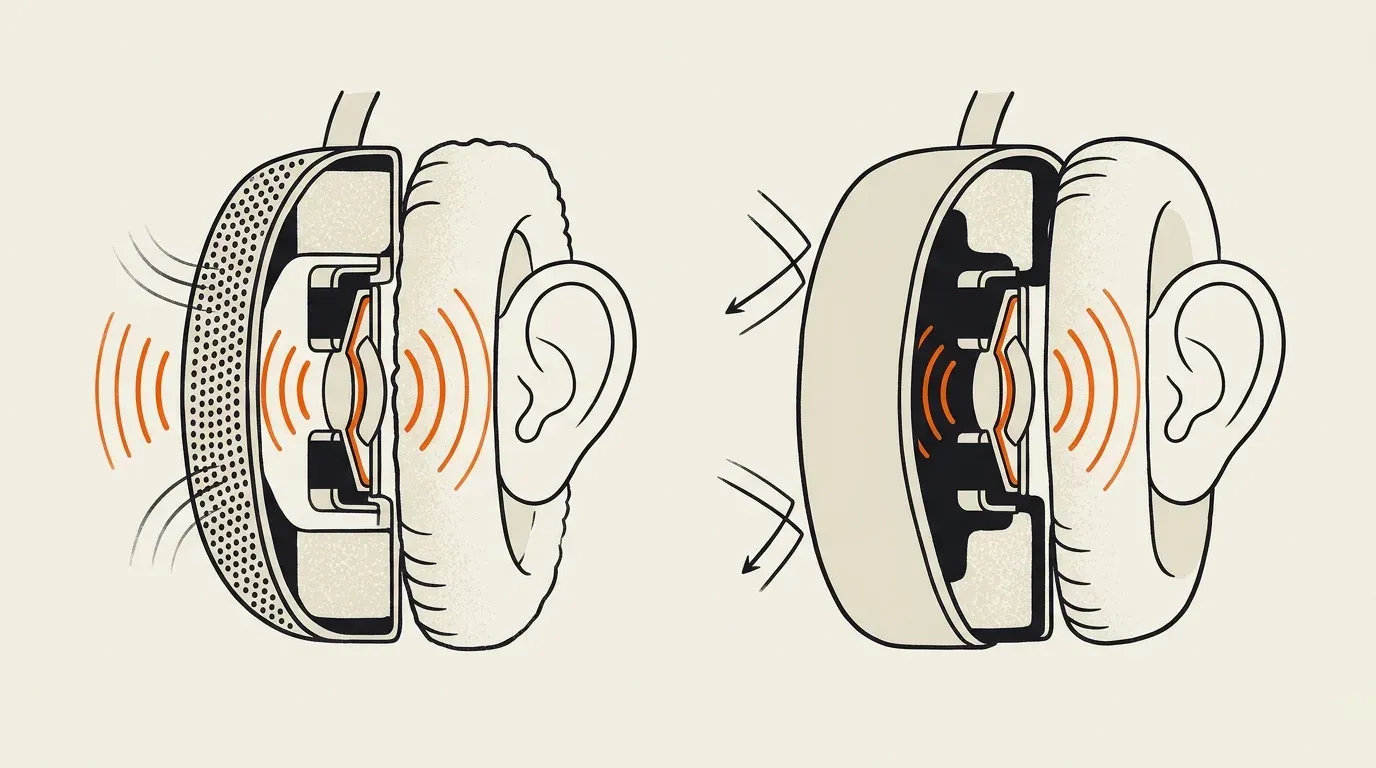
Open-back (left): sound leaves through the grille and the room comes in. Closed-back (right): the shell keeps your music in and most outside noise out.
Start with what’s around you
Before you compare sound, look at the room you’ll use them in. A microphone, other people and outside noise all push you toward closed-back.
If you record vocals, an instrument or a podcast with a mic in the same room, open-backs leak into it. Beyerdynamic says this is why studios use closed headphones for vocal recording.
Other people hear open-backs too. In a quiet room, the person next to you can follow your music, and a desk mic for calls or games picks it up. One HD 560S owner posted on Reddit last month that teammates kept complaining about hearing their own voices come back through the game chat.
Open-backs also block almost nothing coming in. One r/headphones owner in a noisy apartment could only enjoy their open-backs early in the morning, before rush hour, while their DT 770 kept the noise out. In a loud room people turn the volume up to cover the noise, and over months that’s hard on your ears.
If you sit alone in a quiet room and don’t record, open-backs are worth a look, since that’s the setup they’re designed for. Beyerdynamic calls the open design ideal for home use, and Audio-Technica pitches its open-back R-series for mixing in a studio or another private space.
Recording: closed-backs leak too
Closed-back is the standard for tracking, and Reddit threads keep landing on that answer. “Open-back headphones are specifically discouraged for recording vocals,” as one r/musicproduction reply puts it. With a strong singer, bleed from the backing track is usually minor, since that track ends up in the mix anyway. A click track or a part you later cut is the problem, because its bleed stays in the vocal take.
Closed-backs leak as well once you push the volume up. On r/audioengineering, someone recording on an ATH-M50 hears the instrumental behind the vocal because the singer likes it loud. There are similar threads about the MDR-7506, and one M50x owner in our research notes a little bleed at high monitoring volume. Keep the headphone mix as quiet as you can sing to, and move the mic so it isn’t right next to the earcup.
Want to check your own pair? Play a song through the headphones at your usual level, set them where your head would be in front of the mic, and record a few seconds in our free mic test. If you can hear the song on playback, the mic will hear it during a take too.
How they sound
Open-backs sound wider. Instruments seem to sit around your head, more like speakers in a room, and less like they’re playing between your ears. Five of the seven usable top reviews of the HD 560S in our studio headphones research mention its wide stereo image, and owners call it neutral enough to find problems in a mix. Audio-Technica credits the open design with fewer internal reflections and a wider soundstage.
Closed-backs sound closer and have more bass punch. The sealed cup helps the low end, which producers of electronic music like and mixing engineers distrust. One r/TechnoProduction reply sums up the DT 770 as stronger in the low end with good isolation, “but more fatiguing.” A closed-back’s bass also depends on the seal. HEDD, which makes open-backs, points out that open designs sound the same however they sit on your head. If thick glasses frames lift a closed-back’s pads off your skin, you’ll lose some of the bass.
You can hear the difference in sound, but leakage and isolation decide more about whether a pair works for you. Plenty of home mixes get finished on closed-backs.
Comfort and heat
A sealed cup traps heat. Two DT 770 Pro owners and one ATH-M20x owner in our research mention warm or sweaty ears, and Beyerdynamic notes that open designs let the heat between ear and cup escape. HEDD calls open-backs more comfortable for long sessions for the same reason.
Pads and clamp still count for more than the earcup type. The DT 770 Pro is closed-back and still gets the most comfort praise of any pair we’ve covered, thanks to its velour pads. The ATH-M50x is closed too, and its clamp has drawn complaints for a decade.
Gaming and movies
Gamers don’t agree. Open-backs have a following for story games and for placing sounds around you. Closed-backs win with a loud mechanical keyboard, for bass in action games, and whenever you use a mic for voice chat. Reddit threads asking “will my mic leak footsteps” are mostly open-back owners. If you play with a separate mic and don’t want to fiddle with noise suppression, closed-back is the easier choice.
Semi-open: the middle ground
Some headphones, like the Beyerdynamic DT 880 Pro and the AKG K240, are semi-open: vented, but less than a full open-back. They sound more spacious than most closed ones and leak less than open ones. Beyerdynamic says the bass escapes almost unhindered while the highs are damped, so they still aren’t quiet next to a sensitive mic. Some home studio owners on Reddit still use the K240 for tracking.
Which one should you buy?
You record vocals, instruments or podcasts
Closed-back. The ATH-M50x, MDR-7506 and DT 770 Pro in our studio headphones guide are all closed. If you’re still choosing a mic too, our vocal microphone guide covers the other half of the bleed problem.
You mix in a quiet room
Open-back, ideally as a second pair. The HD 560S is our pick for mixing, and it runs fine from an audio interface’s headphone output. Check that yours has one with our audio interface guide.
You share a room, a dorm or an office
Closed-back. With open-backs, everyone nearby hears your music.
You listen on the bus, at work or around the house
Closed-back, and for real commuting, a pair with noise canceling. Open-backs block nothing, so you’d end up turning them up.
Only buying one pair?
Closed-back. It does every job well enough, including mixing, while an open-back pair leaks into your mic and struggles in a noisy or shared room. Plenty of people add an open-back pair later for mixing.
Ready to pick one?


Questions beginners ask
Can people hear what I'm listening to with open-back headphones?
Yes, in a quiet room they can. At normal volume, someone sitting next to you will hear the music clearly, and a mic on your desk will pick it up. One HD 560S owner on Reddit had teammates on voice chat hearing their own voices come back, and fixed it by turning on Discord's echo cancellation, lowering the volume and adjusting the mic's sensitivity. Closed-back headphones leak much less, though turned up loud they leak too.
Are open-back headphones better for your ears?
What matters for your hearing is how loud and how long you listen, not the earcup. Open-backs let outside noise in, so in a noisy home or on a bus people tend to turn them up to cover it. Closed-backs let you listen quieter in the same place. In a quiet room, the difference mostly goes away.
Should I use closed-back or open-back headphones for gaming?
Gamers are split. Open-backs sound wider, which some players like for placing footsteps and for story games. Closed-backs keep a loud keyboard and the room out, give explosions more punch, and don't leak into your mic. If you use a desk mic or a headset mic for voice chat, closed-back saves your teammates from hearing the game twice.
Are open-back headphones better for mixing?
Many engineers prefer them, because they sound closer to speakers in a room and closed-backs can exaggerate the bass. Closed-back headphones still work for mixing, especially in a noisy home. Whatever you mix on, check the mix on earbuds, a car or speakers before you call it done.
Can I record vocals with open-back headphones?
You can, but the mic will hear them. A loud singer on a dynamic mic may get away with it at low volume. A click track or a part you later cut is the usual problem, because its bleed stays in the vocal track. Closed-backs are the standard for tracking.
What are semi-open headphones?
A middle design with a partly vented earcup, like the Beyerdynamic DT 880 Pro or the AKG K240. They leak less than fully open headphones and sound more spacious than most closed ones. Beyerdynamic says the bass escapes almost freely while the highs are damped, so a mic still hears some of the low end.
What are the three types of headphones?
When people ask about earcups, the answer is closed-back, open-back and semi-open. By fit, the usual three are over-ear, on-ear and in-ear. The studio headphones in our guide are all over-ear.