Active vs passive speakers: which setup makes sense for you?
Forums argue about which one sounds better. For a first stereo, the gear you already own and what you'll want to change later usually decide it first.
 By Douglas MatosoUpdated
Heads up: we earn a commission if you buy through our Amazon links, at no cost to you. It never decides our picks. Affiliate disclosure
The short answer
Active (or powered) speakers have the amplifier built in: plug them into the wall and your source and you're done. Passive speakers have no amp, so you add an amplifier or receiver and speaker wire. Starting from nothing, a powered pair is the simpler and usually cheaper setup. If you already own a receiver, or want to upgrade the speakers and the amp separately over the years, go passive.
Side by side
| Active (powered) | Passive | |
|---|---|---|
| Amplifier | Built into the speaker | A separate amp or receiver |
| What you plug in | Speaker to the wall and to your source | Amp to the wall; speaker wire to each speaker |
| Extra cost | None | An amp, plus speaker wire |
| Inputs | Whatever the speaker has | Whatever the amp has |
| Upgrading | Replace the whole pair | Swap the amp or the speakers on their own |
| If the electronics fail | The speaker goes in for repair | Swap the amp; the speakers keep working |
| Best for | Desks, turntable starters, small rooms, one-box simplicity | Owners of a receiver, home theater, upgraders |
| Examples from our guides | Edifier R1280T, Edifier R1280DB, Kanto YU4 | Sony SS-CS5, Klipsch R-41M, Polk T15 |
Where the amplifier lives
A speaker can’t make sound from the tiny signal your phone, TV or turntable puts out. Something has to amplify it first. Active and passive speakers differ in where that amplifier sits.
An active or powered speaker has it inside the box. You plug the speaker into the wall, run a cable from your source, and that’s the whole system. In most of the budget pairs we cover, only one speaker holds the amp and the knobs. The second one connects to it with speaker wire. The Edifier R1280T works like that, and so do the Fluance and Audio-Technica pairs in our turntable speakers guide.
A passive speaker is just the drivers and the crossover in a box. It needs a separate amplifier or receiver, which plugs into the wall and sends power to each speaker over speaker wire. The Sony SS-CS5, Klipsch R-41M and Polk T15 are all passive.
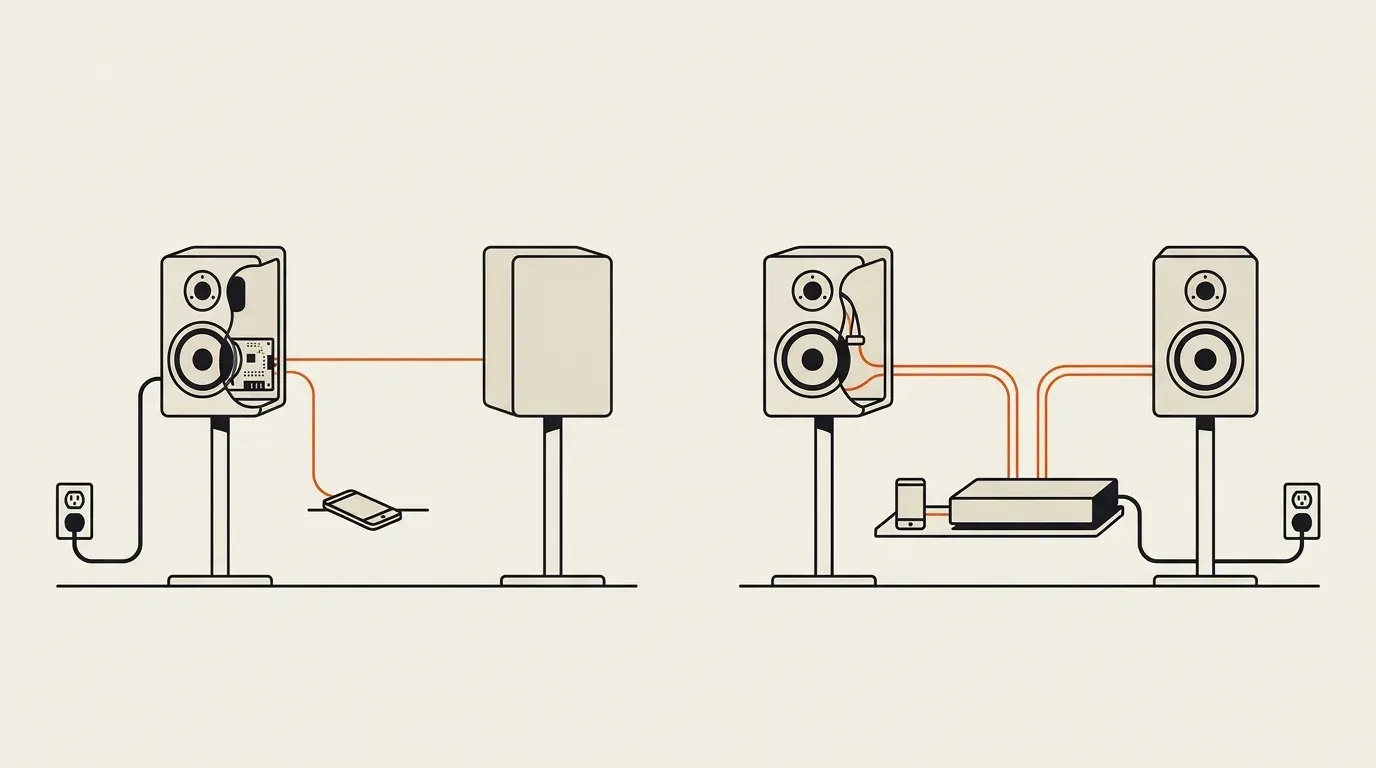
Powered (left): the amp sits inside one speaker. Passive (right): a separate amp powers both speakers through speaker wire.
People in audio forums sometimes split “active” and “powered” into two things. QSC, which makes pro speakers, defines a fully active speaker as one with a separate amp for each driver, and a powered speaker as one amp feeding a normal crossover. On Amazon and in most stores the two words mean the same thing, and we use them that way here.
Start with what you already own
If you own a receiver or an amp, passive speakers plug straight into it, and you’ve already paid for the amp. Buying a powered pair would leave the receiver sitting unused. If the receiver has a phono input, a turntable plugs in without a separate preamp.
If you’re starting from nothing, a powered pair is one purchase that needs one outlet. In an r/hifiaudio thread from a beginner about to buy a first turntable, one reply points out that active speakers are usually a bit cheaper than an amp plus passive speakers. Another calls powered speakers “a great option” on a budget, and says an amp with passive speakers “can be, not always, a step up.”
If you’re setting up a turntable, check for a phono preamp first. As one r/BudgetAudiophile reply puts it, you always need one, built into the turntable, the amp or the speakers. Of the five powered pairs in our turntable speakers guide, only the Kanto YU4 has one. A receiver with a phono input covers it on the passive side.
What it costs
A powered pair comes with everything inside. A passive pair needs an amp too, plus speaker wire, so add those to the cost before you compare. ELAC, which sells both kinds, says the same: if you go passive, “budget for an amplifier as well.”
The amp doesn’t have to be big. On r/BudgetAudiophile, small class D amps like the Fosi BT20A and the Aiyima A07 come up again and again as the budget choice. Owners in our bookshelf speakers research run the Sony SS-CS5 on Fosi and Aiyima amps and on AV receivers. Speakers with high sensitivity need less power. The Klipsch R-41M is rated at 90 dB, the highest of our passive picks, and owners drive it with tiny amps.
Which one sounds better
Neither side wins every time. On Audio Science Review, many members argue active designs have more potential, because the maker picks the amp for those exact drivers. ELAC makes the same point about its own powered speakers. Others in the same threads answer that “implementation is everything”: a well-designed passive speaker can match an active one. Budget pairs get less love. In that r/hifiaudio thread, one of the top-voted replies calls affordable active speakers “a compromise and mediocre at best.” Reddit threads asking the question run past 100 comments without an agreement.
At budget prices, two other things matter more. The speaker itself is the first: a good passive pair on a modest amp can beat a weak powered pair, and the other way around. Placement is the second. An ASR member put it plainly: a well-placed passive speaker will outperform a badly placed active one. Get the speakers off the desk or the turntable shelf and away from the wall, and point them at where you sit.
The amp also limits some passive speakers. Three owners of the ELAC Debut B5.2 in our research say the speaker is held back mostly by the amp they run it on, and one r/hifiaudio reply warns that a poor match between amp and speakers “is more common than people think.” With a powered pair, the maker has already made that match, for better or worse.
Once your speakers are set up, our free speaker test checks left and right, catches a speaker wired backwards, and sweeps the bass to show how low they go.
Upgrades and repairs
Over the years, passive speakers have the edge. With separate parts, you can replace the amp with one that has Bluetooth or more power, or keep the amp and move up to bigger speakers. One r/BudgetAudiophile reply calls a passive setup “a much more budget friendly upgrade path as you will only need to upgrade the speakers.” ELAC lists future amp upgrades as the main reason to go passive.
A powered pair is one unit. When you outgrow it, you replace the whole thing, and when the electronics fail, the speaker fails with them. Fluance warns that if one amp module stops working, “you might lose an entire speaker.” On r/BudgetAudiophile, the reply that calls active better for “quality and cost efficiency” also calls passive “the way to go for repairability”: built-in electronics fail more often, and replacement parts may be gone ten years later. The parts that usually wear out in a passive speaker, the woofer surrounds and the crossover capacitors, can be replaced. That poster’s dad still runs 47-year-old Tannoys after new surrounds.
Long-time owners on Audio Science Review tell the same story. One had three active speakers whose built-in amps died at around ten years old, with no replacement from the maker, while their 30- to 40-year-old passive speakers still play. Closer to our price range, r/audiorepair has posts about Edifier R1700BT power boards dying, and one R1280DB owner on r/audio lost Bluetooth after a little over a year.
Plenty of budget powered speakers run for years without trouble, though. Two Edifier R1280T owners in our research report more than a year of daily use with no problems. Check the warranty: the Edifier, Kanto and Fluance pairs in our guides come with two years.
Setup and connections
A powered pair has fewer parts but more cables at the speakers themselves. The powered box needs an outlet nearby, and if the pair has an amp in each speaker, as studio monitors and PA speakers usually do, each one needs its own outlet. Passive speakers don’t plug into the wall at all, which helps when one sits far from a socket.
Inputs come from whatever holds the amp. With powered speakers, check the back of the box: the Edifier R1280DB has Bluetooth, optical for a TV and a subwoofer output, while the R1280T has two RCA inputs and nothing else. With passive speakers, the amp decides, so you can pick one with the inputs you need. If you connect a turntable, a TV and a computer, a powered pair ends up with every cable hanging off one speaker, as one longtime owner on r/hifiaudio points out. With an amp, the cables go to a box on the shelf.
Never wire an amplifier’s speaker outputs into a powered speaker’s inputs. Powered speakers expect a line-level signal from a phone, a TV or a preamp, and an amp’s output is much stronger.
Which one should you buy?
A first stereo, a desk or a small room
Powered. A pair like the Edifier R1280T is one box to buy and one outlet to find. If you don’t plan to upgrade and may add bass later, look for a pair with a subwoofer output, which is the advice one r/BudgetAudiophile reply gives a first-time buyer in that spot. An R1280DB owner in the same thread calls theirs “currently perfect” and plans to move up eventually. Our budget bookshelf speakers guide covers it next to the passive options.
A turntable setup
Powered, if the turntable or the speakers have a phono preamp. Our powered speakers for turntables guide lists which pairs have one, and our turntable guide says which record players do. If you already own a receiver with a phono input, passive speakers plug straight into it.
You already own a receiver or an amp
Passive. Your amp is paid for, and any of the passive pairs in our bookshelf guide will work with it.
A TV or a home theater
Passive speakers with an AV receiver, if you plan to add a center channel, surrounds or a sub. A powered pair with an optical input, like the Edifier R1280DB, works for a simple stereo setup under a TV.
You like to upgrade one part at a time
Passive. You can change the amp or the speakers later without replacing both.
Ready to pick one?


Questions beginners ask
What are the disadvantages of active speakers?
You can't change the amp. The inputs, the power and the sound of the built-in electronics are what you live with until you replace the pair. If the electronics fail, the speaker stops working, and Fluance, which sells both kinds, warns that losing one amp module can take out a whole speaker, and forum owners report built-in amps dying with no replacement parts after about ten years. Some powered speakers also hiss a little when nothing is playing. One Audio Science Review member calls audible hiss one of the most common complaints about active speakers, and it's easiest to hear up close at a desk in a quiet room.
What sounds better, passive or active speakers?
Neither, as a rule. Active designs have a technical edge, because the maker matches the amp to the drivers, and many Audio Science Review members argue they come out ahead. Others there point out that a good passive design can sound just as good, and that the specific speaker matters more than the type. At budget prices, the speaker itself and where you put it make a bigger difference. One ASR member put it this way: a well-placed passive speaker beats a badly placed active one.
Do passive speakers need power?
Not from the wall. They get all their power through the speaker wire from the amplifier, so only the amp needs an outlet. That's handy if a speaker sits far from a socket.
Can I connect passive speakers to powered speakers?
Not to add more speakers. In most powered pairs, the second box is a passive speaker made for that one pair, and the speaker outputs are meant only for it. Also, never wire an amplifier's speaker outputs into a powered speaker's inputs. Those inputs expect a line-level signal, and the amp's output is much stronger.
Can I use an active subwoofer with passive speakers?
Yes. Plug the sub into your amp's or receiver's subwoofer output. If your amp doesn't have one, check whether the subwoofer accepts speaker-level inputs before you buy.
Is there a difference between active and powered speakers?
Strictly, yes. In a fully active speaker, each driver gets its own amplifier and the crossover works before the amps. In a powered speaker, one amp feeds a regular crossover inside the box. QSC, which makes pro audio speakers, uses those definitions. Stores and Amazon listings use the two words for the same thing, and for choosing a home setup the difference rarely matters.
What is an active PA speaker?
A loudspeaker for live sound, like the ones bands and DJs set on stands, with the amplifier built in. Each one plugs into the wall and takes a signal straight from a mixer. Home powered speakers work the same way, but in most of the budget pairs we cover only one box has the amp.