Condenser vs dynamic microphone: which one suits your room?
Most guides say dynamic mics block background noise. Owners agree, but the reason is where you sit, and that changes how you should choose for the room you record in.
 By Douglas MatosoUpdated
Heads up: we earn a commission if you buy through our Amazon links, at no cost to you. It never decides our picks. Affiliate disclosure
The short answer
Buy a dynamic mic if you record speech or vocals in an ordinary bedroom or office and can sit 2 to 6 inches from the mic. Buy a condenser if your room is quiet and soft, you want more detail and air in the sound, or you can't stay that close. Condensers need 48V phantom power. Dynamic mics need more gain from your interface.
Side by side
| Dynamic | Condenser | |
|---|---|---|
| How it works | A coil on the diaphragm moves in a magnet and makes its own signal | A charged diaphragm next to a backplate, with a small preamp inside |
| Power | None | 48V phantom power on XLR models (USB models get it from the computer) |
| Output | Low, so it needs more gain | High: an AT2020 puts out over 7 times the voltage of an SM58 |
| Where you sit | 2-6 in. away (RØDE) | 4-8 in. away (RØDE) |
| Sound | Focused and a bit darker | More detail and top end |
| In a bare, noisy room | Forgiving, as long as you stay close | Records the echo and the noise along with you |
| Common examples | Shure SM58, SM7B, Samson Q2U, RØDE PodMic | Audio-Technica AT2020, RØDE NT1, Blue Yeti |
How each one turns your voice into a signal
In both types, sound hits a thin diaphragm and makes it move. They differ in how that movement becomes a signal.
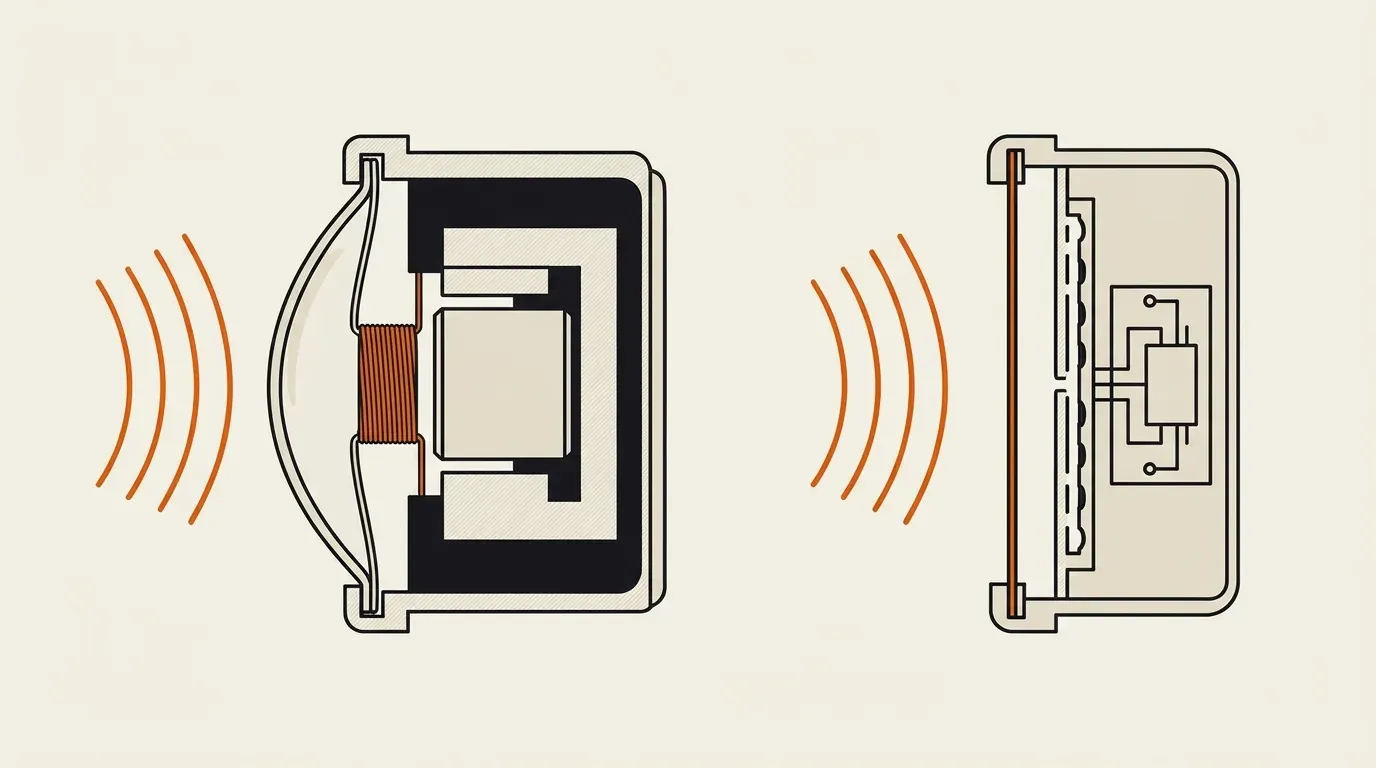
Dynamic (left): the diaphragm moves a coil around a magnet. Condenser (right): a thin diaphragm sits just in front of a charged backplate, with a small preamp behind it.
In a dynamic mic, the diaphragm is glued to a small coil of wire that sits in a magnet. When the coil moves, it makes a tiny electric current on its own. There’s no circuit inside and nothing to power, which is part of why mics like the Shure SM58 have a reputation for surviving drops. Several SM58 owners in our vocal mic research say theirs has been dropped and kept working, and one still uses a 20-year-old unit.
In a condenser mic, the diaphragm sits very close to a charged metal plate. As it moves, the gap between them changes, and so does the voltage. That signal is too weak to send down a cable, so a small preamp inside the mic boosts it first. The preamp needs power, which is why XLR condensers need 48V phantom power from your interface or mixer. USB condensers like the Blue Yeti get theirs from the computer.
Room noise is mostly about distance
You’ll read everywhere that dynamic mics “block” background noise and condensers “pick up everything.” Owners do report it that way. In our research, three of the eight top Amazon reviews of the Audio-Technica AT2020 mention room and background noise, and four of eight AT2020USB-X owners name a furnace vent, a gaming PC, a keyboard or a leaf blower outside. SM58 owners say the opposite: it keeps the background out.
But both kinds hear the room in the same pattern. Most home mics in either group are cardioid: they pick up what’s in front and less from behind. The difference is how close you sit and how much gain you need.
A dynamic mic puts out very little signal. By the makers’ spec sheets, an AT2020 puts out more than seven times the voltage of an SM58 for the same sound. So with a dynamic, you have to get close (RØDE suggests 2 to 6 inches) to get a usable level. At that distance your voice is far louder than the fan across the room, and the room ends up quiet in the recording.
A condenser gives you a good level from farther away, so people sit back (RØDE suggests 4 to 8 inches) or put it on the desk at arm’s length. Now your voice is closer in level to the room, and the condenser records both. This point comes up again and again on r/microphone: a dynamic doesn’t hear less of the room, it just makes you sit where the room matters less. One reply puts it bluntly: in a noisy space, “keeping a dynamic mic close is really the only option.”
If you can’t fix your room, sit close to the mic. A dynamic mic makes you do that, because it won’t give you a usable level from farther away. One Reddit post calls the AT2020 “a reverb machine” in an untreated room, and one SM7B owner in our research replaced an AT2020 for exactly that reason. Several owners in our podcast mic research made the same move from a Blue Yeti to a dynamic mic.
Not sure how noisy your room is? Our free mic test measures how much room noise your current mic picks up, right in the browser.
How they sound
Condensers catch more detail and more of the top end: breath, the edges of consonants, the shimmer of an acoustic guitar. That’s why they’re the usual pick for studio vocals. It can also be too much. AT2020 owners on Reddit call its highs “brittle” or say it has “too much high end,” and the answer they get is usually to treat the room.
Dynamic mics sound more focused and a bit darker. That suits speech, and it hides some harshness in a voice. For singing it splits people. Some owners love the SM7B’s “warm, full, smooth” sound, while others call an SM58 “muddy” or ask why it sounds “amazing live but flat at home.”
Power and gain: what your interface has to do
Condensers need 48V phantom power. Nearly every audio interface has a 48V button. A condenser stays silent until you turn it on, and “my AT2020 stopped working” threads usually end with someone pointing at phantom power or the cable.
Dynamic mics need gain instead. Most are fine on a basic interface, the SM58 included. A few are much quieter. Shure recommends at least 60 dB of gain for the SM7B, and RØDE PodMic owners report running a Focusrite Scarlett Solo at full gain and still needing to be within an inch or two. If you buy one of those, check your interface’s maximum gain or plan on an inline booster like a Cloudlifter.
Our audio interface guide lists the gain each pick gives you.
USB doesn’t tell you which kind it is
Plenty of people think “USB mic” means condenser. It doesn’t. The Blue Yeti and the AT2020USB-X are condensers, but the Samson Q2U, the FIFINE AM8 and the Shure MV7+ are dynamic mics with USB. The type decides how the mic treats your room, and USB or XLR decides what you plug it into.
Durability, with a caveat
Dynamic mics have the tougher reputation, and the SM58 owners in our research back it up. DPA, which makes condensers, argues that a well-built condenser can take rough handling too. When condenser owners post about buzzing, hiss or dropouts, the replies we read usually point at phantom power, the cable or the input setting before the mic itself.
Which one should you buy?
Podcasting, streaming, gaming and calls
A dynamic, unless your room is quiet and treated. You’ll sit close anyway, and it keeps keyboards, fans and the street down. Start with our podcast microphone picks, all of which are dynamic.
Singing at home
It depends on the room. Clap your hands where you’ll record. If you hear a ring or a slap back, go dynamic (SM58 or SM7B). If the room is small, carpeted and full of soft furniture, a condenser like the AT2020 or RØDE NT1 will give you more detail. Our vocal microphone guide has both kinds.
Acoustic guitar, piano and quiet instruments
Usually a condenser. These sources are soft and full of detail, and you can’t always get a mic within a few inches of them.
Loud sources and the stage
Usually a dynamic. Guitar amps, snare drums and live vocals are the classic jobs for dynamic mics, and on stage you want the mic to ignore the monitors and the band next to you.
Not sure, and only buying one?
A dynamic mic with both USB and XLR, like the Samson Q2U, is the safe first mic. It works in nearly any room, plugs straight into a laptop, and moves to an interface later if you get one.
Ready to pick one?


Questions beginners ask
Is a dynamic mic better than a condenser?
Neither is better across the board. A dynamic mic is easier to get a clean recording from in an untreated room, because you work close to it. A condenser catches more detail and suits quiet, soft rooms, singing and acoustic instruments. Pick for your room first and your sound second.
Do singers use dynamic or condenser mics?
Both. On stage, most singers use dynamic mics like the Shure SM58. In a studio, condensers are the usual choice for vocals. At home it depends on the room. Singers with an echoey or noisy room often get a better take on a dynamic, and some owners find an SM58 sounds darker and flatter at home than a condenser does.
How do I know if my mic is dynamic or condenser?
Look up the model on the maker's site. The spec sheet names the type. If the manual says the mic needs 48V phantom power, it's a condenser. USB doesn't tell you anything on its own. The Blue Yeti is a condenser, while the Samson Q2U and FIFINE AM8 are dynamic mics.
Should I get a condenser or dynamic mic for gaming or streaming?
For most gaming setups, a dynamic. A gaming PC's fans and a mechanical keyboard sit right next to the mic, and owners of USB condensers like the AT2020USB-X name exactly those noises as their main complaint. A dynamic mic on an arm close to your mouth keeps them much quieter.
What are the disadvantages of a condenser microphone?
It hears more of the room, so echo, fans and traffic end up in the recording unless the room is quiet and soft. XLR condensers need 48V phantom power, so you need an interface or mixer that has it. Most also need a pop filter and a shock mount, which often aren't in the box.
What are the disadvantages of a dynamic microphone?
You have to stay close, about 2 to 6 inches away, and your level drops quickly when you lean back. It needs more gain, and some dynamic mics like the Shure SM7B and RØDE PodMic need more than a basic interface gives. The sound is less detailed and airy than a condenser's, which matters more for singing than for talking.
Can I use a dynamic mic for recording vocals at home?
Yes. Plenty of home singers use an SM58 or an SM7B, mainly because their room works against a condenser. Sing close, use the gain your interface has, and expect a warmer, less airy sound than a condenser gives.